
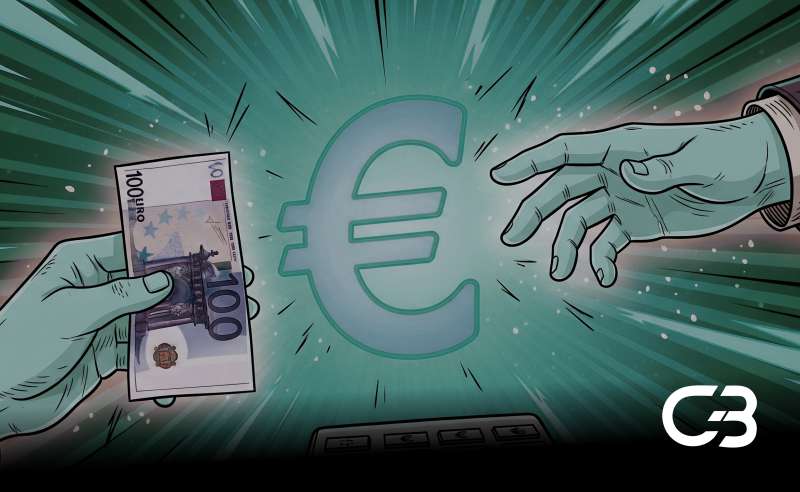
- The EU hastens Digital Euro plans and looks to public blockchains to issue the currency.
- Presently, Etheruem and Solana are top on the list.
- Choosing a public chain will boost wider adoption and boost circulation of the Euro.
The EU hastens Digital Euro plans and looks towards public backlash over opting for a private chain. Officials reveal that Ethereum and Solana are top contenders for the public blockchain that the EU is currently considering for building the Digital Euro. The entity is also remaining cautious of privacy concerns if this decision were to be taken, as all transactions will be available on a public network.
EU Hastens Digital Euro Plans
The European Union (EU) has been considering launching the Digital Euro for quite a few years now. Much like many other countries looking to launch their own digital currencies as stablecoins to ensure transparency to their people, the Digital Euro will cater to the nations associated with the European Union. A digital currency will allow immutable and transparent transactions alongside privacy.
The digitization of currencies has been slowly being tested or considered across various countries. For instance, the Digital Yuan has already been tested in the launch phase over the past few years, with China taking great caution to provide security and also encouraging its citizens to make the shift comfortably. So far, all Digital Yan test launches have gone very well, and it’s only a matter of time before experiencing full adoption.
Entity Considers Ethereum and Solana Over a Private Network
Meanwhile, other countries are trying to catch up. Thus, the EU’s attempt to hasten the development of the Digital Euro gains traction. Presently, EU officials are weighing the options of issuing the Digital Euro on a public chain over a private chain. In detail, the top two public chains being considered to issue the Digital Euro are Ethereum (ETH) and Solana (SOL), both popular networks.
As we can see from the post above, responses to the post are filled with the crypto community engaged in public discussions. While some weigh the pros and cons of which blockchain will win out, others comment on the EU for looking to public chains as this proves that they are truly looking to decentralizing control and make all Digital Euro transactions transparent, showcasing the entity’s take on accountability.
Until recently, the European Central Bank was pursuing a private chain, a closed system for the digital currency, due to privacy concerns. However, it seems now it is leaning towards a public chain to encourage wider adoption and greater circulation for the Euro. If they want to improve privacy, perhaps they can consider Cardano and Midnight, as these offer the same as Solana and Ethereum, plus more.